👁 Views: 9,199
8 Word Stress Rules in English Pronunciation
|
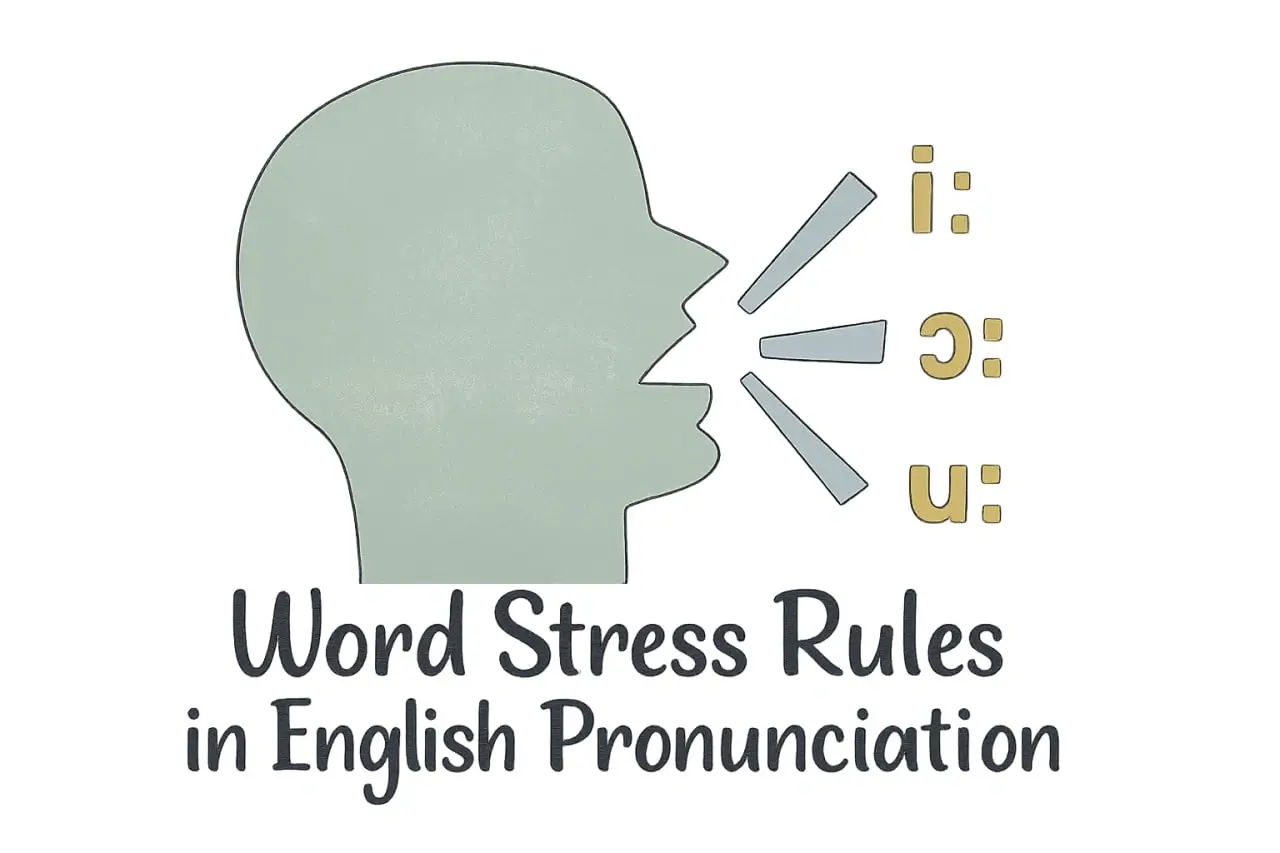
Understanding Word Stress Rules in English is essential for clear and natural communication. In fact, the stressed syllable in a word is pronounced louder, longer, and with a higher pitch. Moreover, misplacing stress can lead to confusion or misunderstanding. Therefore, we’ll explore 8 core Word Stress tips in English with practical examples to help you speak like a native. |
Why Mastering Word Stress Rules in English MattersIn reality, stress isn’t just about sound—it’s about meaning. Many learners know a word but fail to recognize it in conversation due to incorrect stress. Additionally, improper stress makes speech sound unnatural. Consequently, mastering Word Stress Tips in English enhances both speaking and listening comprehension. |
Word Stress vs. Intonation in English PronunciationStress highlights a specific syllable within a word, while intonation shapes the melody across a sentence. For example, “REAlly” always stresses the first syllable, but the sentence “Really?” can express surprise (rising tone) or doubt (falling tone). Both are vital for natural English. |
How to Practice Word Stress Rules in English EffectivelyTo internalize Word Stress Rules in English, try these strategies: First, actively listen to native speakers in podcasts or movies. Second, tap your hand on the stressed syllable while repeating words. Third, consult dictionaries like Cambridge—they mark stress with /ˈ/ (e.g., /ˈbeau-ti-ful/). With consistent practice, your ear will adapt naturally. |

|
Word Stress Rules in English dictate which syllable to emphasize in a word. Stressed syllables are louder, longer, and clearer. Sentences also have rhythm—function words (e.g., “the”, “and”) are reduced, while content words carry stress. For instance: “Dessert” /de-SSERT/ (sweet course) vs. “Desert” /DES-ert/ (arid land). The difference lies entirely in stress. Key Example: Dessert /de-SSERT/ = post-meal treat Desert /DES-ert/ = sandy wilderness We indicate stressed syllables in CAPS (e.g., /BEAU-ti-ful/). |
1- Word Stress Rules in English: Two-Syllable Nouns & AdjectivesStress usually falls on the first syllable. table /TA-ble/ scissors /SCI-ssors/ pretty /PRE-tty/ clever /CLE-ver/ |
2- Word Stress Rules in English: Two-Syllable Verbs & PrepositionsStress usually falls on the second syllable. present /pre-SENT/ export /ex-PORT/ aside /a-SIDE/ between /be-TWEEN/ |
3- Noun-Verb PairsAs a noun, stress is on the first syllable; as a verb, on the second. present /PRE-sent/ (gift) present /pre-SENT/ (to show) export /EX-port/ (goods) export /ex-PORT/ (to send abroad) suspect /SU-spect/ (person) suspect /su-SPECT/ (to believe) Note: respect always stresses the second syllable. |
4- Words Ending in -er & -lyFor three-syllable words ending in -er or -ly, the stress typically lands on the first syllable. orderly /OR-der-ly/ quietly /QUI-et-ly/ manager /MA-na-ger/ |
5- Words Ending in -ic, -sion, -tionStress falls on the penultimate syllable (second-to-last). creation /cre-A-tion/ commission /com-MI-ssion/ photographic /pho-to-GRA-phic/ |
6- Words Ending in -phy, -ty, -cy, -gy, -alNotably, stress usually falls on the third-to-last syllable in these words. democracy /de-MO-cra-cy/ photography /pho-TO-gra-phy/ logical /LO-gi-cal/ commodity /com-MO-di-ty/ psychology /psy-CHO-lo-gy/ |
7- Compound NounsIn compound nouns, stress consistently falls on the first part. football /FOOT-ball/ keyboard /KEY-board/ housewife /HOUSE-wife/ shopkeeper /SHOP-keeper/ taxi-driver /TAXI-driver/ |
8- Compound Adjectives & Phrasal VerbsAs a result, stress usually falls on the second part of these expressions. old-fashioned /old-FA-shioned/ well-behaved /well-BE-haved/ understand /un-der-STAND/ get along /get A-LONG/ |