👁 Views: 32,350
💰 A penny saved is a penny earned: A smart proverb about saving money!
🌟 A Penny Saved Is A Penny Earned Proverb For Kids: A smart proverb about saving money!
Welcome, little savers! Today we explore the wise a penny saved is a penny earned proverb for kids. Have you ever decided to save money instead of spending it? For instance, perhaps you put your allowance in a piggy bank instead of buying candy. This proverb teaches us something important about money and smart choices. Saving a penny equals earning a penny. In other words, keeping your money adds value to your pocket! Furthermore, this saying helps us understand that small savings grow into something big over time. Now, let us discover what this wise saying really means and how it can help you become a smart saver!
For example, imagine you have $5. If you spend it all on candy, it vanishes. However, if you save $1 each week, after 10 weeks you will have $10! That is the magic of a penny saved is a penny earned!
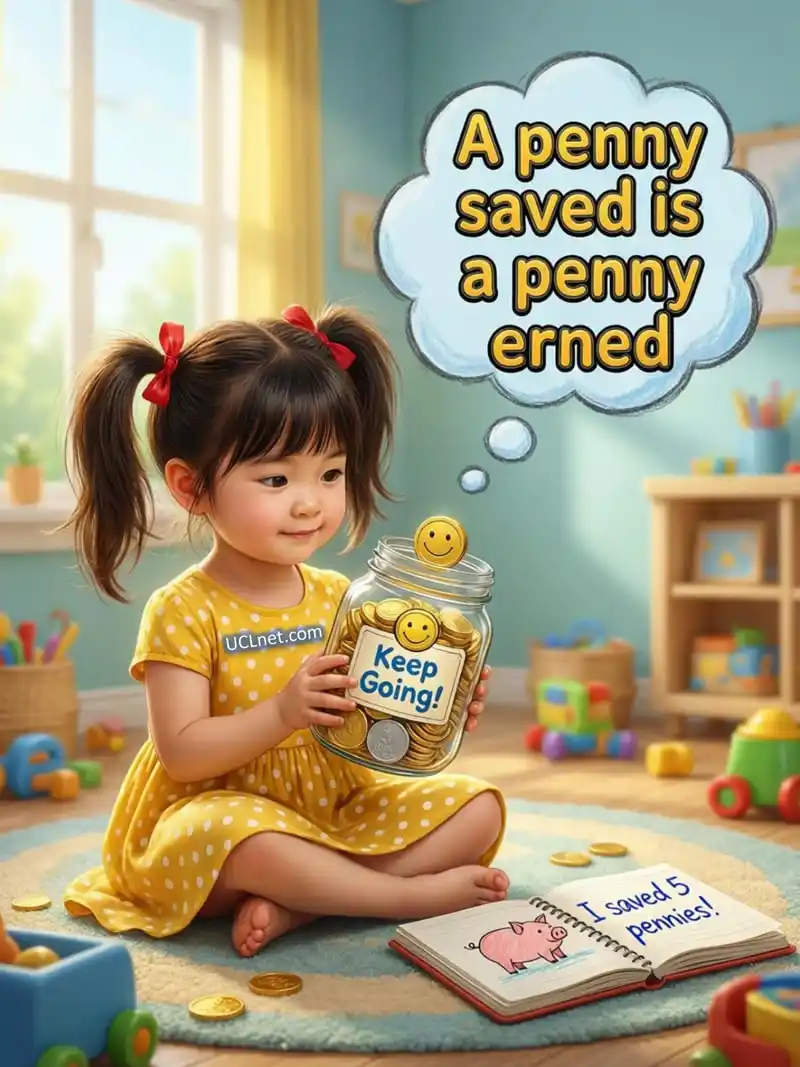
🌱 A Penny Saved Is A Penny Earned Proverb For Kids: What does this smart saying mean?
To begin with, this proverb conveys a clear and powerful message. Basically, saving money holds the same value as earning it. In other words, every penny you keep adds to your wealth just like earning a new penny. Consequently, this saying encourages children to act smart with their money. Moreover, it reminds us that small savings accumulate into significant amounts over time. Specifically, this wise saying teaches children that making good choices with their money truly matters. For example, if you save $2 from your allowance every week, you will have $104 saved in one year!
📖 A Penny Saved Is A Penny Earned: A fun short story about saving
Initially, a boy named Jake spent all his money as soon as he received it. Every week, his grandma gave him $5, and he bought snacks and toys immediately. Unfortunately, Jake never saved any money. Then, one day, he saw an amazing new video game he really wanted. It cost $40, but Jake had zero dollars saved. He felt sad and wished he had exercised more caution.
His grandma said, “Jake, remember that a penny saved is a penny earned. If you save just $2 each week, you can buy that game in 20 weeks.” As a result, Jake started saving his money. Eventually, after 20 weeks, he had $40 and bought the game. Therefore, Jake learned that saving acts like earning money, and small savings definitely add up over time!
🎨 Understanding a penny saved is a penny earned: Meaning and opposite
Literally, this proverb means that saving a penny equals earning a penny. In reality, being careful with your money grows your personal wealth. On the other hand, the opposite idea would be: “Money is meant to be spent” or “Saving does not matter.” However, this wise saying teaches us that smart saving creates financial freedom.
Summary Box: Every penny you save equals earning a penny. Small savings lead to big results over time!
| Category / Source | Detailed Description & Definition |
|---|---|
| Proverb Meaning | Saving money holds the same value as earning money. |
| Literal Meaning | Keeping a penny in your pocket equals adding income. |
| Possible Opposite | Spending everything immediately; refusing to save. |
| Dictionary Definition | A proverb stating that saved money matches earned money in value. |
🔊 A Penny Saved Is A Penny Earned Proverb For Kids: Pronunciation and simple examples
First, the pronunciation guide is: /ə ˈpɛni seɪvd ɪz ə ˈpɛni ɜːrnd/. Next, let us review some simple sentences to understand this wise saying better:
• Primarily, I saved $1 from my allowance today; my mom noted, “A penny saved is a penny earned!”
• Additionally, instead of buying a snack, I placed the money in my piggy bank. Truly, a penny saved is a penny earned!
• Finally, always remember this proverb: every small saving brings you closer to your goal!
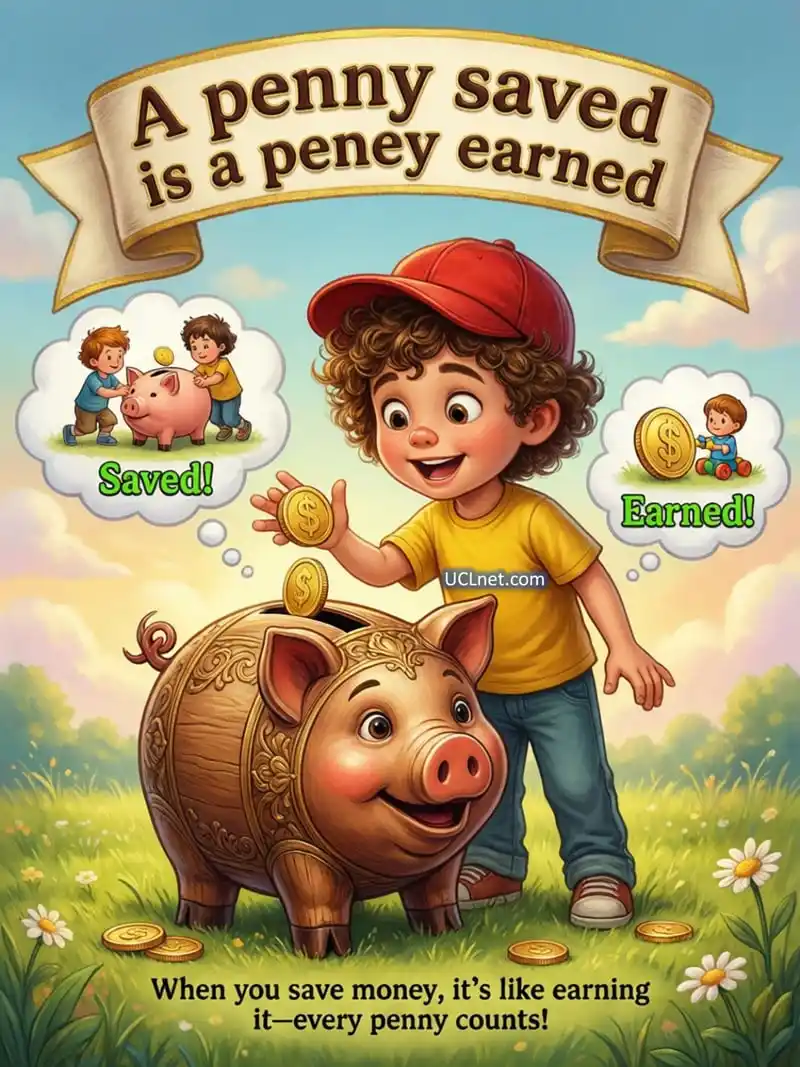
💬 A Penny Saved Is A Penny Earned: Short dialogue for kids about saving money
Mia: I really want that new toy, but it costs $20!
Leo: Do you have any savings, Mia?
Mia: I only have $5 in my piggy bank.
Leo: That offers a good start! Furthermore, remember this saying: a penny saved is a penny earned. If you save $2 each week, you will buy it in 8 weeks!
Mia: You are right! I will start saving more immediately.
Leo: Exactly! Small savings create big things!
📜 The Ancient Roots of “A Penny Saved Is A Penny Earned”
This wise saying possesses a fascinating history that spans centuries! Let us explore its origins.
🇺🇸 Benjamin Franklin and Poor Richard’s Almanack
Benjamin Franklin popularized this proverb. As one of America’s founding fathers, he offered practical money advice in his 1737 book, Poor Richard’s Almanack. Franklin wrote: “A penny saved is a penny got” or “A penny saved is a penny earned”. He believed that small daily habits yield big results over time.
📖 Earlier Versions
The concept of saving money dates back even further! A similar saying appeared in English as early as the 1500s. The English writer George Herbert included in his collection of proverbs (1640): “A penny in the purse is a penny earned”. Clearly, people have valued the wisdom of saving for hundreds of years!
🌍 A Universal Lesson
Cultures around the world recognize this proverb. Many societies possess similar sayings about saving money and guarding resources. This proverb teaches that small savings add up over time and that financial prudence constitutes a valuable life skill.
💡 Lesson: Benjamin Franklin taught us that saving small amounts today creates financial freedom tomorrow. Every penny counts!
⚙️ Where to use this proverb for kids: Different meanings and grammar tips
📍 Situational usage
Interestingly, people apply this proverb in many situations! For example, when you save your allowance, it reinforces the value of saving. When you avoid purchasing something unnecessary, it encourages smart choices. When you save for a long-term goal, it motivates you to persist. The message remains consistent: saving constitutes a form of earning!
📝 Grammar tips
Regarding grammar, this proverb utilizes a parallel structure that aids memorability. Consequently, children can employ this proverb to discuss their savings goals, whereas adults often use it in financial advice.
⚠️ Common mistakes to avoid
Some children mistakenly say “a penny saved is a penny gained”. The correct version remains a penny saved is a penny earned. Furthermore, avoid thinking this proverb only applies to pennies; it applies to any sum of money!
📚 Mini-dictionary for new vocabulary
| Word | Simple Meaning for Kids |
|---|---|
| Proverb | A wise, traditional saying. |
| Penny | A small coin worth one cent. |
| Save | Keeping money for later. |
| Earn | Receiving money through work. |
| Allowance | Money given to children regularly. |
| Piggy Bank | A container for coins. |
| Wealth | Money and valuable assets. |
| Frugal | Avoiding waste; careful with money. |
🔗 Synonyms and related phrases
Here exist similar sayings that share the same message:
• A dollar saved equals a dollar earned (the modern version)
• Money saved matches money earned
• Waste not, want not (careful resource use prevents shortage)
• Save for a rainy day (keeping money for later)
• Every penny counts (small amounts accumulate)

👨👩👧 Parents and teachers guide for teaching this proverb to kids
Educators can introduce this proverb when discussing money or financial literacy. Above all, maintain a practical and encouraging tone so children appreciate the importance of saving. In addition, remind them that this proverb encourages making smart choices with their money.
🎯 Fun classroom and home activities
🏃 Class game: Initiate a “saving challenge” where children save a small amount weekly and track progress!
🎨 Home task: Ask kids to illustrate their savings goal and write the proverb underneath.
🎭 Acting time: Organize shopping scenarios where children practice making smart, informed choices!
❓ Common questions
Q: Is this proverb too complex for children?
A: Not at all! Simple examples involving allowances make this concept accessible for children aged five and up.
Q: How can I make this proverb engaging?
A: Utilize games, saving challenges, and stories featuring characters who save for their dreams!
📝 Worksheet quiz about this proverb for kids
Finally, test your knowledge of this wise saying with this fun quiz! Parents and teachers can utilize it to assess comprehension.
Click here to show Answer Key
1. Saving money is as valuable as earning it
2. Proverb
3. earned
4. Benjamin Franklin
5. To keep money for future use
6. False
7. To receive money for work
8. Saving $2 from your allowance each week
9. A container for saving coins
10. Small savings add up to big results
📚 Explore More Money Proverbs for Kids
Want to become even smarter with your money? Check out our full collection:
📚 Explore More Related Lessons
Want to practice more? Check out our special categories: