👁 Views: 2,402
📚 Ambiguous vs. Ambivalent: Difference & Meaning for Kids
✨ What Is the Difference Between Ambiguous and Ambivalent?
When reading fascinating stories or chatting with classmates during school breaks, young learners frequently encounter twin words that look almost identical on paper but express completely different concepts. Specifically, mastering the ambiguous vs ambivalent puzzle helps growing students avoid confusing usage mistakes in their daily writing. But do these two challenging terms puzzle you and your young students? Actually, caring teachers and supportive parents constantly look for straightforward methods to explain tricky vocabulary to children. Therefore, this comprehensive guide provides crystal-clear rules, engaging memory tricks, real-life error corrections, and easy everyday examples. In addition, knowing how to pick the precise word builds rock-solid reading confidence from an early age. Consequently, exploring these interesting word differences transforms English grammar learning into an enjoyable daily adventure for every child.
For instance, knowing when to use each term stops you from mixing up an unclear story plot with experiencing mixed emotional feelings about a choice!

📚 Deep Dive Into Ambiguous Meaning and Uses
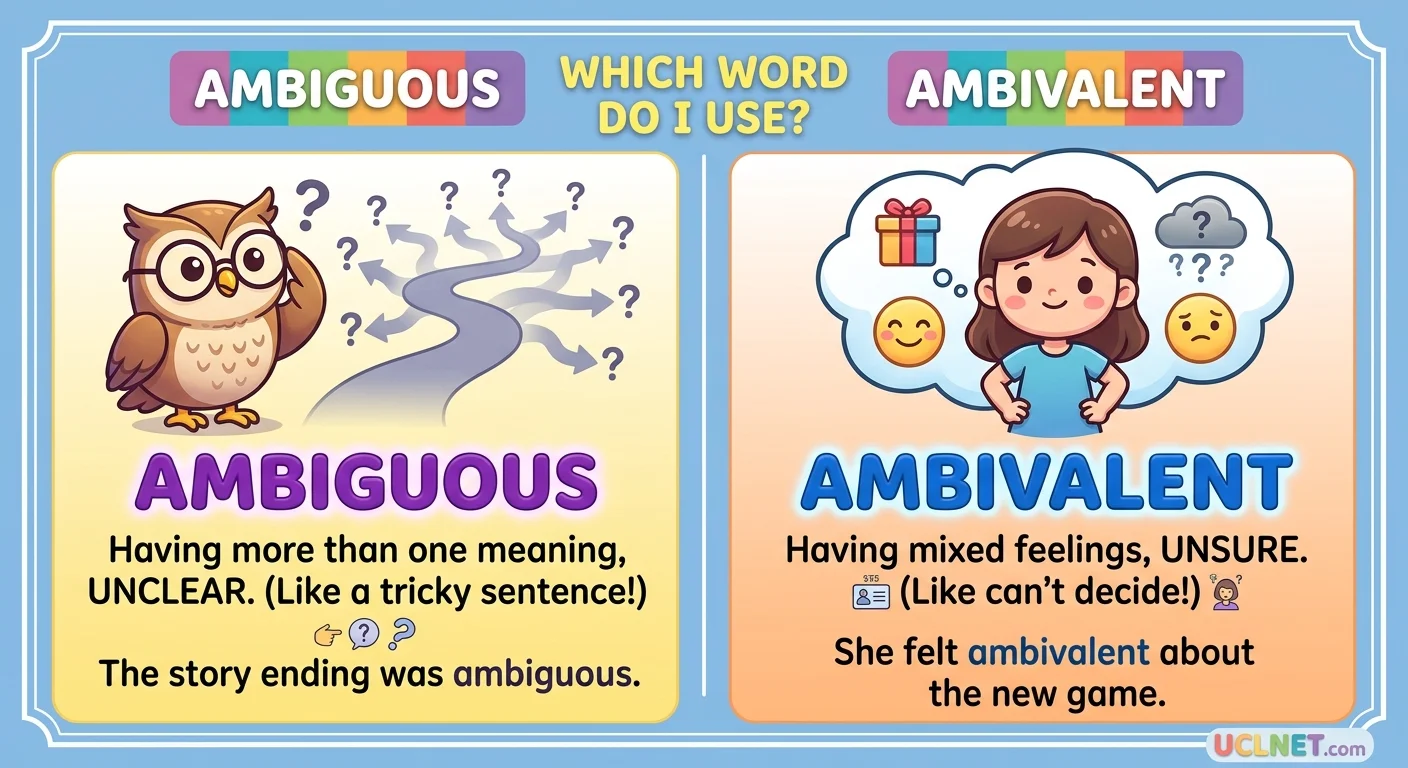
Let us carefully examine the first word in our twin pair. First, what does ambiguous mean? As a descriptive adjective, it refers to something that contains more than one possible interpretation, making it unclear or difficult to decode immediately. For example, imagine reading an exciting mystery book where the final chapter does not clearly reveal who solved the puzzle, leaving the ending completely open to your own imagination. Therefore, understanding ambiguous helps students describe mysterious situations accurately. In addition, here are key structural facts about this wonderful word:
1. Having More Than One Meaning
Meaning: Open to multiple interpretations and lacking a single definitive explanation.
Example: Accordingly, the ending of the short story is ambiguous; we simply do not know why he disappeared.
2. Unclear Instructions
Meaning: Presenting spoken or written directions that can be interpreted in several separate ways.
Example: Similarly, the art teacher gave project instructions that felt ambiguous, prompting everyone to ask extra questions.
🔍 Exploring Ambivalent Meaning and Feelings
Now, let us explore our second vocabulary term. What does ambivalent mean? As an adjective, it describes an individual person who experiences mixed feelings, hesitation, uncertainty, or deep doubt regarding a decision. For example, if your close friend asks whether you want to join a brand new after-school club, you might feel thrilled about making new friends but simultaneously worried about having extra homework assignments. Therefore, ambivalent serves as a highly useful term to explain having two opposing emotional currents at the exact same time. In addition, parents and teachers can utilize this expression to guide kids through expressing complex inner feelings. Consequently, mastering this word helps young learners understand personal emotions with greater clarity.
Having Mixed Feelings
Meaning: Being unsure, doubtful, or experiencing conflicting emotional responses simultaneously.
Example: Instead of feeling fully certain, he was ambivalent as to which club candidate to vote for during the election.
📊 Quick Comparison: Ambiguous vs. Ambivalent
To make things exceptionally simple for students, please review this quick comparative chart before attempting our practice quiz:
| Word | Core Meaning | Example Sentence |
|---|---|---|
| Ambiguous | Having more than one possible meaning or being unclear. | The rules of the board game were ambiguous to new players. |
| Ambivalent | Feeling uncertain, unsure, or having mixed emotions. | She felt ambivalent about moving to a brand new school. |
💡 Teacher & Parent Guidance & Memory Tricks
To help parents and classroom teachers explain these confusing words effectively during study sessions, please utilize these proven pedagogical tips:
- Memory Trick (Meaning vs Feelings): Remind children that ambiguous relates to guessing multiple meanings in a sentence, whereas ambivalent contains the root ‘val’ like value, indicating that you are weighing two opposing emotional values in your mind.
- Real-Life Common Error Correction: Students frequently write: “I am ambiguous about eating green broccoli for dinner.” This sentence structure is incorrect because vegetables do not possess multiple sentence meanings! The accurate word choice is ambivalent because it describes mixed personal feelings toward eating broccoli.
- Interactive Classroom Activity: Have students hold up two different colored cards when asked a tricky question to physically experience feeling ambivalent in real time.
💬 Easy Everyday Dialogues for Kids
In addition to formal rules, listening to everyday conversations helps children speak natural English. Therefore, read these short dialogues out loud together with your family members or school classmates:
Dialogue 1:
Leo: “Did you completely understand the movie ending today?”
Sam: “No, it was very ambiguous and left us all guessing.”
Dialogue 2:
Teacher: “Are you excited about our upcoming school field trip?”
Student: “I feel ambivalent because I love the science museum, but I strongly dislike long bus rides.”
📖 Mini Dictionary for Young Learners
Before attempting the interactive practice quiz below, please review these essential vocabulary words featured directly inside our lesson text:
| Word | Simple Meaning | Example Sentence |
|---|---|---|
| Unclear | Not easy to see, hear, or understand clearly. | The written instructions for the playground game were unclear. |
| Uncertain | Not completely sure about something. | He was uncertain about what exact time the birthday party started. |
| Doubtful | Feeling unsure or questioning a decision. | It seemed doubtful that it would snow during the summer season. |
| Candidate | A person who is trying to win a vote or position. | Every student candidate gave a wonderful speech to the class. |
📝 Practice Quiz: Ambiguous vs. Ambivalent
Test your understanding of ambiguous vs ambivalent using this interactive quiz designed specifically for classroom practice and home study:
Click here to show Answer Key
1. Having more than one meaning or being unclear
2. True
3. Unclear
4. ambiguous
5. False
6. He was ambivalent as to which candidate to vote for in the election.
7. Uncertain
8. To prevent usage mistakes and build confidence
9. ambivalent
10. Candidate
📚 Explore More Related Categories
Want to discover more English vocabulary lessons and confusing words? If so, explore our related categories below: