👁 Views: 160
🌟 Honey Badger Alphabet: H is for Honey Badger!
Welcome back to our ultimate animal alphabet adventure! Are you ready to walk through the wild savanna and meet one of the bravest creatures in the world? This amazing honey badger alphabet lesson makes exploring the letter H super fun for everyone!
Particularly, discovering wild animals helps young students pick up new words much faster. Furthermore, by joining us today at UCLnet.com, you will practice your reading skills while finding out cool wildlife facts. Therefore, let’s begin this magnificent safari journey together right now!
1. Meet Your Wild Friend: The Honey Badger Alphabet
Our new honey badger alphabet highlights a very special mammal that lives across beautiful grasslands. For instance, it has tough gray skin on its back and is famous for being incredibly strong, small, and totally fearless!
- Vocabulary Word: Honey Badger
- Phonic Sound: /ˈhʌn.i ˈbædʒ.ər/ (Hun-ee Bad-jer)
- Special Feature: Super thick skin and sharp claws to find sweet beehives!
- Natural Home: Sunny savannas and warm underground burrows
Interestingly, these animals are very smart because they follow a tiny bird called the Honeyguide to find hidden food. Consequently, studying their smart teamwork protects our knowledge of nature.

Discovering brave safari animals turns everyday letter practice into a dynamic quest!
2. Why the Honey Badger Alphabet Inspires Young Minds
Learning English with brave creatures helps children memorize phonics sounds much better than simple word lists. Indeed, whenever kids see how a small badger can stand up to big lions on the savanna, they become incredibly curious to read more.
Moreover, the honey badger alphabet method teaches daily grammar while showing wonderful nature facts. Because these badgers never give up, learning about them feels like a real backyard treasure hunt. Thus, this active animal topic effectively turns regular vocabulary practice into a memorable game.
3. Practicing the Honey Badger Alphabet Sounds
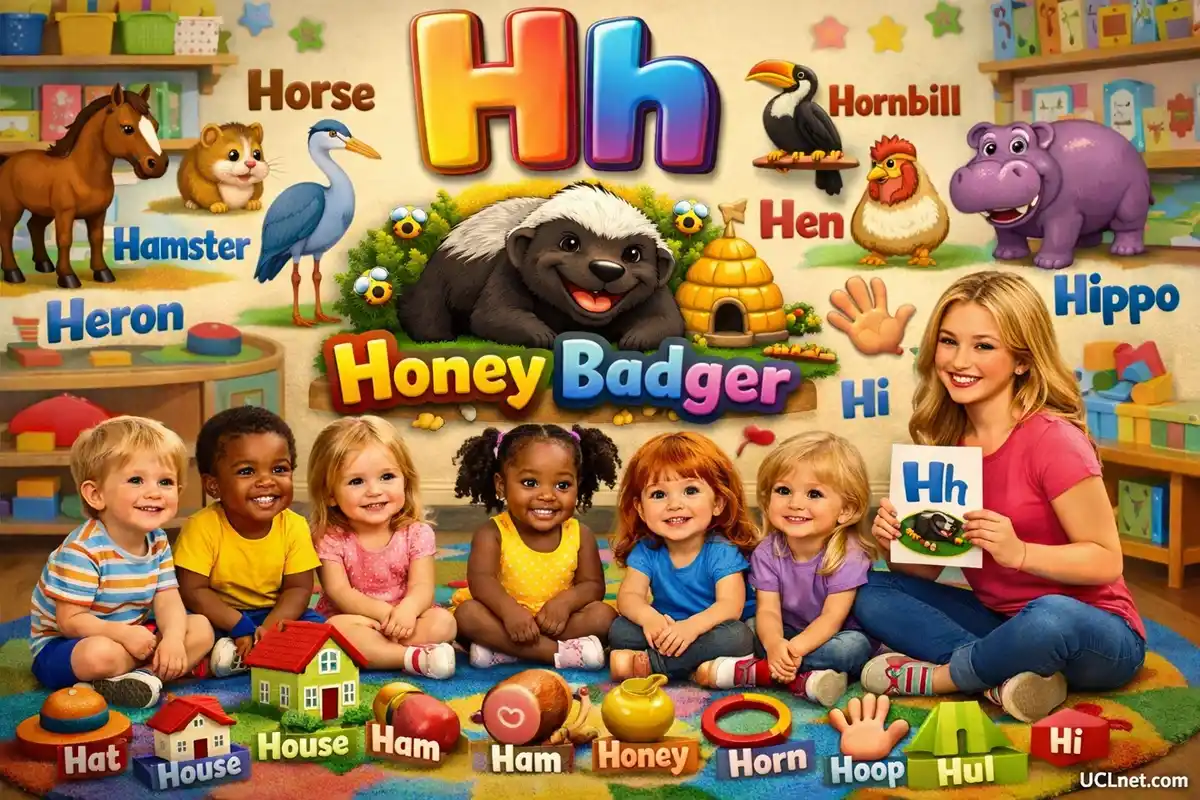
Now, let us practice our special letter H sounds together. First of all, open your mouth slightly and blow out a gentle puff of warm air onto your hand, just like saying the words Hat, House, Ham, and Hen.
Next, try saying “Honey Badger” very slowly: Hun-ee Bad-jer. Afterward, see if you can think of other wonderful H animals that live around our world or parts of your body like your Hand. Additionally, you should look at this list:
- Hamster (A tiny, fluffy pet that runs on a wheel)
- Horse (A tall, fast animal you can ride)
- Husky (A beautiful dog with thick fur that loves snow)
- Hippopotamus (Or a huge Hippo swimming in the river)
- Honeybear (A cute forest mammal that loves sweet treats)
- Heron (A beautiful bird standing on long legs near water)
- Hornbill (A wild bird with a very large, heavy Horn)
Essentially, you might imagine this cute badger walking up a steep Hill to find a colorful rolling Hoop, and giving its friendly animal family a warm, loving Hug!
Quick Classroom Quiz: Which word starts with the /h/ sound?
To begin, is it Honey Badger or Dolphin?
Moving on, is it Hamster or Monkey?
Finally, is it House or Yellow?
📚 Mini Dictionary
| Word | Simple Meaning |
|---|---|
| Alphabet | A group of letters we use to write words (like A, B, C). |
| Honey Badger | A small, very brave animal with thick fur that loves honey. |
| Savanna | A large, warm grassy land with green trees and lots of sun. |
| Fearless | Very brave; not afraid of anything. |
| Mammal | An animal with warm blood and fur that feeds its babies milk. |
Speaking new animal words out loud builds amazing reading confidence!
📝 Free Honey Badger Alphabet Worksheet
To ensure students grasp the concepts fully, this worksheet provides targeted exercises. Specifically, these activities will help reinforce the /h/ sound.
Part A: Multiple Choice Questions
Initially, let’s explore these questions to test your knowledge.
Part B: True or False Challenge
Subsequently, please attempt these statements to see if you have been paying attention.
Part C: Fill in the Blanks
Moreover, you should fill in the missing letters to complete the animal names correctly.
Part D: English Writing Practice
Finally, practice your writing skills with these two final tasks.
Ultimately, consistent practice of these writing tasks will improve your motor skills. Therefore, try to complete this worksheet at least twice this week.
4. Expanding Your Animal Alphabet Collection
In conclusion, our interactive honey badger alphabet adventure was a huge success. Soon, we will meet the majestic Iguana for the letter I! This natural method makes language learning a wonderful journey for students.
Instead, rather than simply memorizing things, you are discovering spectacular creatures from around our globe. Likewise, please keep filling out your school journal and add a brand new friend every week. Consequently, you should keep exploring with us to constantly grow your skills!
✳️ Explore More Related Lessons
Want to practice more? Check out our special categories and channels for young learners:
Watch animated videos on our channel: