👁 Views: 3,956
Loose vs Lose: Meaning, Differences & Fun Quiz for Kids
What Is the Difference Between Loose and Lose?
Have you ever wondered why removing a single vowel from the middle of a word can shift its meaning from untied shoelaces to misplacing your house keys? Naturally, when young students write stories or complete school assignments, they frequently encounter confusing look-alike words like loose vs lose that create spelling and pronunciation puzzles. Although these terms look nearly identical on paper, understanding loose or lose requires looking closely at their distinct definitions, parts of speech, and ending sounds. Caring teachers and supportive parents always look for straightforward methods to guide children through tricky vocabulary without feeling overwhelmed. Therefore, this comprehensive guide provides clear definitions, smart memory tricks, practical examples, and an interactive quiz to make learning effortless and enjoyable. Consequently, mastering these spelling differences empowers every child to write and speak with complete confidence. Furthermore, exploring these language nuances early on helps students build a solid foundation for learning English vocabulary.
Specifically, knowing how to choose between loose and lose stops you from mixing up wearing baggy clothes that are not tight with failing to win a soccer match!

Deep Dive Into Loose Meaning and Untied Objects
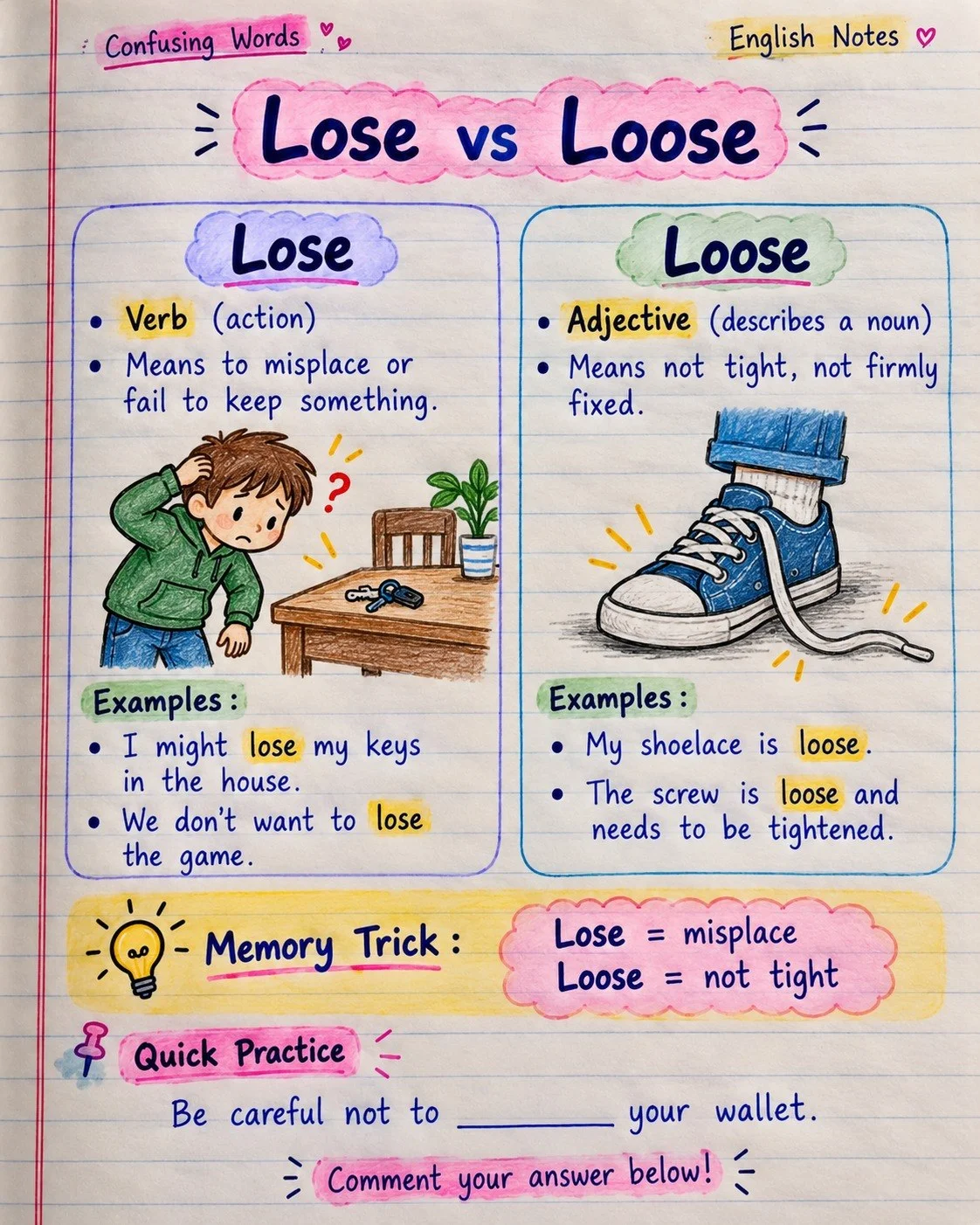
First of all, let us examine our first term in this loose vs lose comparison lesson. What is the true loose meaning? Spelled with two “o”s in the middle, it functions mostly as an adjective describing something that is not tight, not securely fastened, or completely free. Pronounced like goose or juice with a sharp /s/ sound at the end (loo-s), it describes objects with extra room. Specifically, when your sneakers feel untied or a playful puppy slips out of its collar in the yard, they are loose. Therefore, understanding this descriptive word helps students explain fit and freedom accurately. Consequently, recognizing loose or lose in reading exercises becomes much easier for young learners. Furthermore, here are two key ways to understand its usage:
1. Not Tight or Baggy (Adjective)
Meaning: Having extra space or not fitting tightly against the body.
Example: Accordingly, my running shoes feel too loose around my heels today.
2. Free or Unfastened (Adjective)
Meaning: Not tied down, locked up, or securely attached in place.
Example: Similarly, the playful dog got loose in the sunny backyard.
Exploring Lose Meaning and Action Verbs
Meanwhile, let us explore our second grammar term in this loose vs lose guide. What is the complete lose meaning? Spelled with just one “o” in the middle, it functions strictly as an action verb meaning to misplace an item, fail to win a game or contest, or no longer possess something. Pronounced like choose or shoes with a buzzing /z/ sound at the end (loo-z), it expresses an action. For example, when you cannot find your favorite pencil or your sports team finishes in second place, you lose. Therefore, lose serves as an essential action verb for daily conversations. Consequently, learning the difference between loose and lose helps young writers express actions with absolute precision. Moreover, practicing these action verbs daily expands vocabulary confidence.
1. Misplacing an Object (Verb)
Meaning: To be unable to find something that you had earlier.
Example: Specifically, I always lose my house keys when I rush out the door.
2. Failing to Win a Game (Verb)
Meaning: To be defeated in a race, sport, or friendly competition.
Example: Likewise, did our school basketball team lose the final match yesterday?
Quick Comparison: Loose vs. Lose
In short, to make the difference between loose and lose crystal clear before taking our practice quiz, review this quick summary chart:
| Word | Grammar Role & Sound | Example Sentence |
|---|---|---|
| Loose | Adjective (not tight) • Sounds like goose (/s/). | This oversized shirt is very loose. |
| Lose | Verb (misplace/fail to win) • Sounds like choose (/z/). | Be careful not to lose your wallet. |
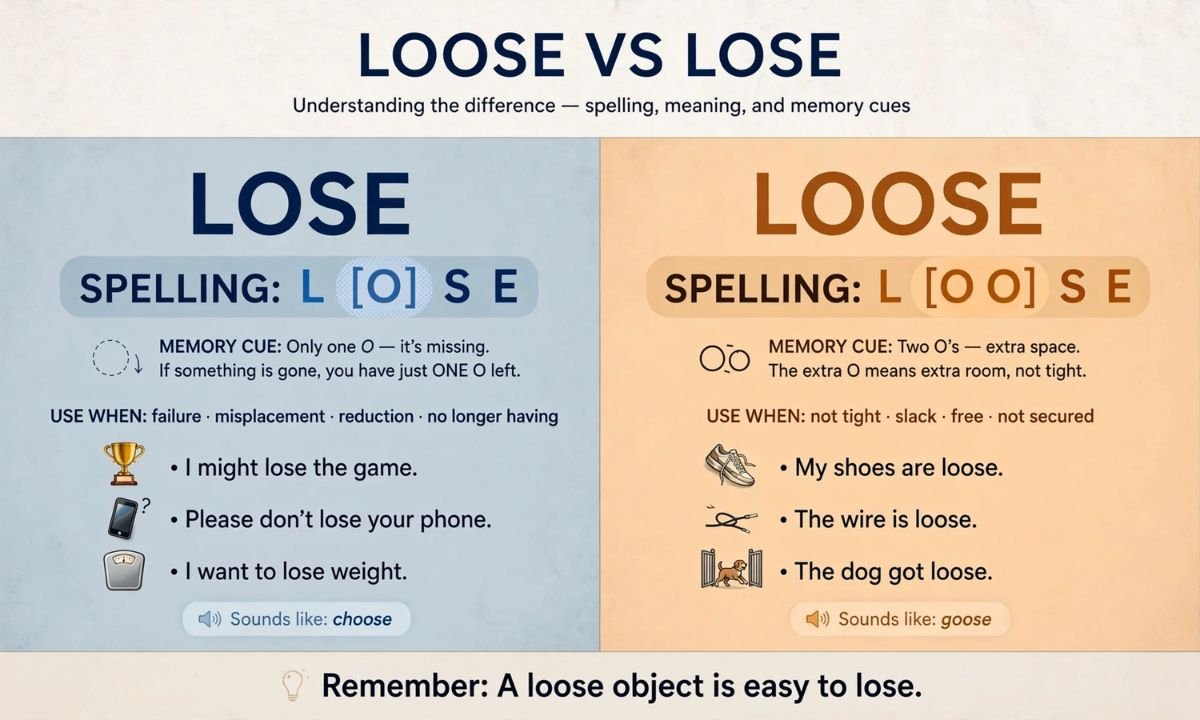 Spelling trick for loose vs lose – UCLnet.com
Teacher & Parent Guidance & Memory Tricks
Furthermore, parents and classroom teachers can use these smart tips during study time when teaching loose vs lose for kids:
- The Double “OO” Roomy Trick: Notice that l-o-o-s-e has two “o”s, which makes it a longer word—just like a loose rope is longer or loose clothing has extra room inside!
- The Missing “O” Trick: Remind kids that l-o-s-e has lost one of its “o”s, so you use it when you lose something!
- The Rhyming Sound Trick: Have students say loose goose (/s/ sound) versus lose shoes (/z/ sound) out loud to hear the difference immediately.
- Real-Life Error Correction: Students frequently confuse loose or lose and write: “I do not want to loose my new toy.” This sentence is incorrect because misplacing an item is lose.
Easy Everyday Dialogues for Kids
In addition to memorizing spelling rules, reading short dialogues aloud helps kids practice loose vs lose in natural sentences. Try practicing these conversations with friends:
Dialogue 1:
Mom: “Tie your shoelaces tightly before running!”
Child: “Good idea, they are very loose right now, and I might trip.”
Dialogue 2:
Coach: “Keep your eyes on the ball during the second half.”
Player: “Yes coach, we will try our best not to lose this game!”
Mini Dictionary for Young Learners
Before taking the interactive quiz below, please review these key vocabulary terms pulled directly from our loose vs lose lesson text:
| Word | Simple Meaning | Example Sentence |
|---|---|---|
| Misplace | To put an object in the wrong place and lose it temporarily. | I often misplace my eraser inside my backpack. |
| Fastened | Closed, tied, or attached securely in place. | Keep your seatbelt fastened during the car ride. |
| Oversized | Bigger than the usual or proper size. | He wore an oversized sweater on the chilly morning. |
| Possess | To own, have, or hold something as your own. | When you lose a toy, you no longer possess it. |
 Difference between loose and lose for young learners – UCLnet.com
Practice Quiz: Loose vs. Lose
Therefore, test your knowledge of loose vs lose by trying these ten practice questions:
Click here to show Answer Key
1. Not tight, not securely attached, or free
2. True
3. Misplace
4. loose
5. True
6. I always lose my keys when I am in a hurry.
7. Fastened
8. To prevent spelling errors and build writing confidence
9. lose
10. Loose goose
Explore More Related Categories
Want to discover more English vocabulary lessons and confusing words? If so, explore our related categories below: