👁 Views: 560
Classroom Objects in English: Learn 39 Essential Vocabulary Words with Examples
Are you learning English for school, work, or daily life? Mastering everyday classroom vocabulary is a powerful first step toward fluency. In this guide, we’ll explore 39 essential English words from Word by Word Pages 4 and 5—perfect for students, teachers, and language learners worldwide.
Whether you’re preparing for an English test, teaching beginners, or simply expanding your vocabulary, understanding these terms will help you describe your learning environment with confidence.
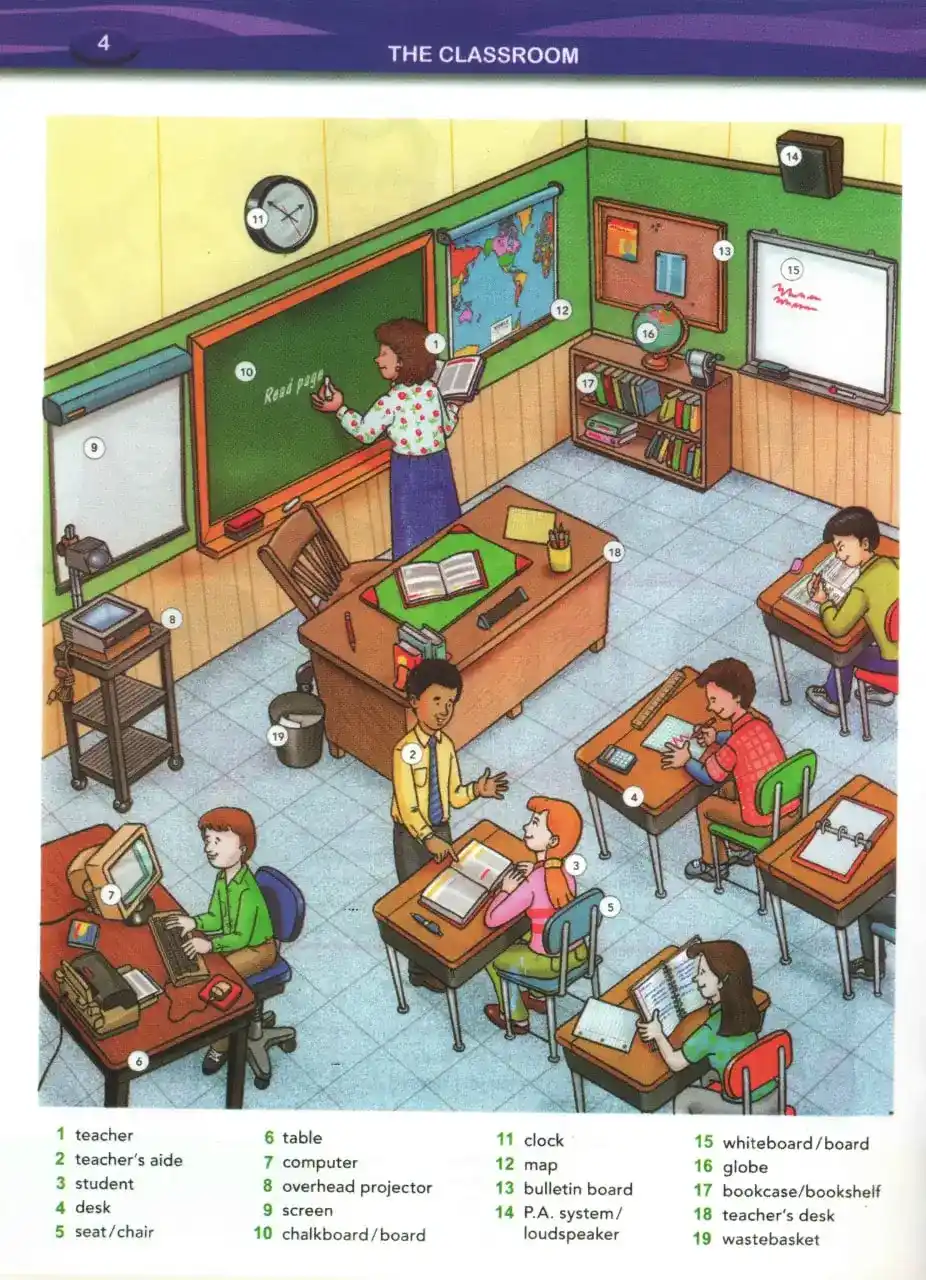
Common Classroom Objects You Need to Know
Let’s begin with the furniture and equipment found in most classrooms:
- Teacher and teacher’s aide – The people who guide your learning
- Student—The learner in the room
- Desk, seat, and chair – Where you sit and work
- Table – Often used for group activities
- Whiteboard and chalkboard – Surfaces for writing and teaching
- Overhead projector and screen – Tools for presenting visuals
- Clock – Keeps time during lessons
- Map and globe – Help you learn geography
- Bulletin board – Displays student work and announcements
- P.A. system / loudspeaker – Used for school-wide messages
- Bookcase / bookshelf – Holds textbooks and reading materials
- Teacher’s desk – The educator’s main workspace
- Wastebasket – For discarding paper and trash

Now, let’s move to the essential writing and tech tools:
- Pen, pencil, eraser, and pencil sharpener – Basic writing tools
- Textbook and workbook – Core learning resources
- Spiral notebook and binder – Organize your notes and assignments
- Notebook paper and graph paper – Used for writing and math
- Ruler and calculator – Essential for accuracy
- Chalk and marker – For writing on boards
- Thumbtack – Holds papers on bulletin boards
- Keyboard, monitor, mouse, and printer – Technology tools for digital learning
Practice Conversations: Ask and Answer in English
Understanding vocabulary is just the start. Use these real-life dialogues to speak naturally:
A: Where’s the teacher?
B: The teacher is next to the board.
A: Where’s the globe?
B: The globe is on the bookcase.
A: Is there a calculator in your classroom?
B: Yes, there’s a calculator on the teacher’s desk.
A: Is there a chalkboard in your classroom?
B: No, there isn’t. We have a whiteboard instead.
These simple question-and-answer patterns are perfect for practicing pronunciation, sentence structure, and classroom vocabulary in context.
Why This Vocabulary Matters
Learning these 39 terms isn’t just about memorizing words — it’s about building the foundation to understand and participate in real English-speaking environments. Whether you’re in a school in Canada, a language center in Nigeria, or studying online from India, these objects are universal.
Teachers: Use this list to create flashcards, quizzes, or interactive classroom games.
Students: Practice describing your own classroom using “There is…” and “Is there…?” structures.
Parents: Help your child learn through daily questions like, “Where’s the pencil sharpener?”
Final Tip: Use These Words Daily
Try labeling items around your home with sticky notes in English. Say the words out loud. Record yourself asking and answering the sample questions. Repetition + context = lasting memory.