

👁 Views: 2,399
Already vs All Ready: Meaning, Differences & Fun Quiz for Kids
What Is the Difference Between Already and All Ready?
Have you ever noticed how adding or removing a single space between two words can completely alter their grammar and meaning in an English sentence? Naturally, when young students write stories or complete school assignments, they frequently encounter confusing homophones like already vs all ready that create spelling puzzles. Although these terms sound identical when spoken out loud, they perform separate jobs and belong to different word groups. Caring teachers and supportive parents always look for straightforward methods to guide children through tricky vocabulary without feeling overwhelmed. Therefore, this comprehensive guide provides clear definitions, smart memory tricks, fun dialogues, and an interactive quiz to make learning effortless. Consequently, mastering these spelling differences empowers every child to write and speak with complete confidence. Furthermore, exploring these language nuances early on helps students build a solid foundation for learning English vocabulary.
Specifically, knowing how to choose the right spelling stops you from mixing up finishing an entire pie beforehand with being completely prepared to go to the park!
Deep Dive Into Already Meaning and Uses
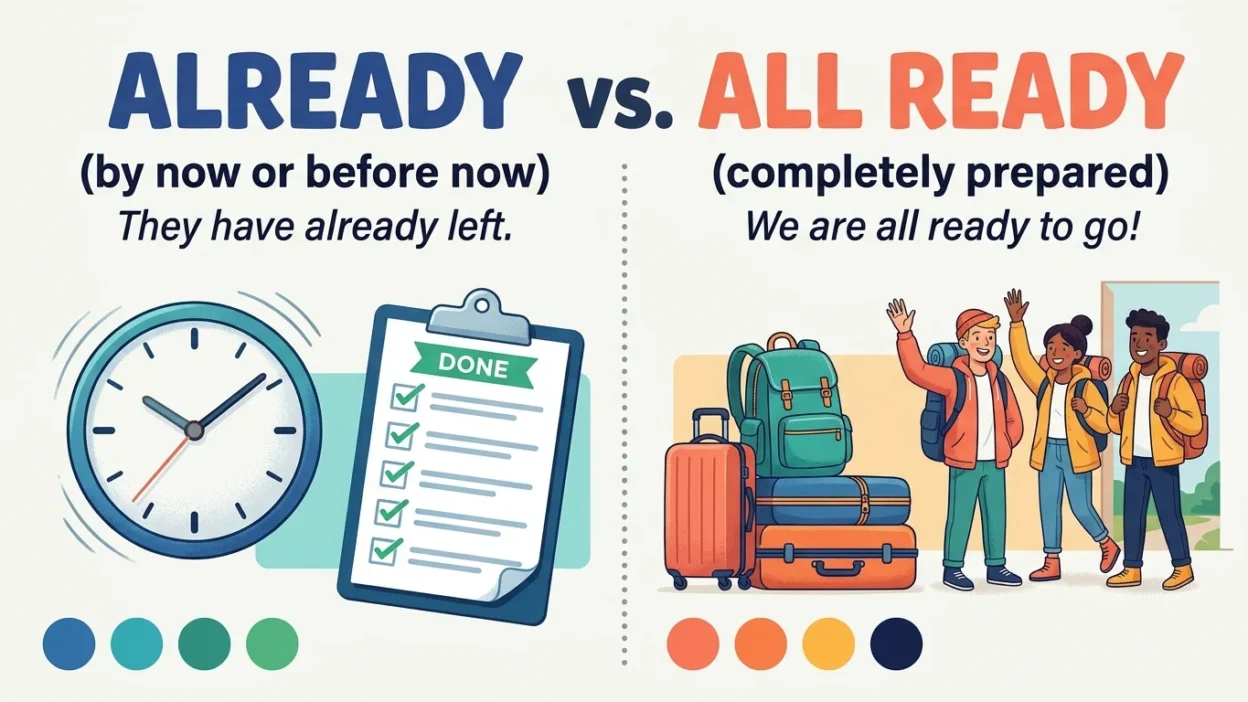
First of all, let us examine our first vocabulary term. What does already mean? Pronounced as (/ɔːl’redɪ/), it functions as a single-word adverb meaning “before now,” “by a certain time,” or “so soon.” Specifically, whenever an action happened prior to a specific moment in the past or present, you use this spelling. Therefore, understanding this adverb helps students describe timelines accurately in school stories. Furthermore, here are two key ways to understand its usage:
1. Prior Actions as an Adverb
Meaning: Happening before a certain time or prior to now.
Example: Accordingly, John had already finished the whole pie by the time his guests arrived.
2. Completed Tasks
Meaning: Indicating that something is done sooner than expected.
Example: Similarly, I have already finished my homework before dinner.
Exploring All Ready Meaning and Preparation
Meanwhile, let us explore our second term. What does all ready mean? Pronounced as (/ɔːl ‘redɪ/), it is a two-word phrase functioning as an adjective phrase meaning “completely prepared” or “fully ready” for an activity. For example, when children put on their jackets and shoes to visit the playground, they are completely ready. Therefore, all ready serves as an essential descriptive phrase for expressing preparation. Consequently, learning this phrase helps young writers describe states of readiness with great precision. Moreover, practicing these phrases daily expands conversational fluency.
Completely Prepared
Meaning: Everyone or everything being fully ready for action.
Example: Specifically, the children were all ready to go to the park.
Quick Comparison: Already vs. All Ready
In short, to make these concepts crystal clear before taking our practice quiz, review this quick summary chart:
| Word | Core Meaning | Example Sentence |
|---|---|---|
| Already | Previously or before a certain time (one word adverb). | John had already finished the pie. |
| All ready | Completely prepared (two words adjective phrase). | The children were all ready to go. |
Teacher & Parent Guidance & Memory Tricks
Furthermore, parents and classroom teachers can use these smart tips during study time:
- The Quick Substitution Test: Try replacing the word in your sentence with just “ready”. If the sentence still makes sense, use the two-word phrase all ready (e.g., “The kids are ready for school”). If replacing it with “ready” sounds wrong, use the single word already.
- Real-Life Error Correction: Students frequently write: “I am already to play games.” This sentence is incorrect because you mean fully prepared; the correct phrase is all ready.
- Interactive Role-Play: Have students practice checking off completed tasks (already) versus lining up for recess when fully prepared (all ready).
Easy Everyday Dialogues for Kids
In addition to memorizing spelling rules, reading short dialogues aloud helps kids speak natural English. Try practicing these conversations with friends:
Dialogue 1:
Dad: “Is John still eating his dessert?”
Mom: “No, he had already finished the whole pie before guests arrived.”
Dialogue 2:
Teacher: “Are we waiting for anyone else before heading out?”
Student: “No, we are all ready to go to the park now!”
Mini Dictionary for Young Learners
Before taking the interactive quiz below, please review these key vocabulary terms pulled directly from our lesson text:
| Word | Simple Meaning | Example Sentence |
|---|---|---|
| Previously | At a time before the present or earlier in time. | She had previously visited the science museum. |
| Prepared | Made ready or equipped for a specific purpose. | The team was well prepared for the big match. |
| Timeline | A graphic representation of the passage of time. | We created a historical timeline of ancient Rome. |
| Substitution | The action of replacing someone or something with another. | The coach made a clever substitution during the game. |
Practice Quiz: Already vs. All Ready
Therefore, check your understanding of already vs all ready by trying these ten practice questions:
Click here to show Answer Key
1. Previously or before a certain time
2. True
3. Previously
4. already
5. True
6. The children were all ready to go to the park.
7. Prepared
8. To prevent spelling errors and build writing confidence
9. all ready
10. Timeline
Explore More Related Categories
Want to discover more English vocabulary lessons and confusing words? If so, explore our related categories below:


