👁 Views: 3,550
Lesson 5 – Let’s Begin 1: Learning the Letter Uu
|
In the previous lessons of Let’s Begin 1, we learned the vowel letters Aa, Ee, Ii, and Oo. Now, we are ready for Lesson 5, which introduces the final English vowel: Uu. This lesson not only teaches the pronunciation and writing of the letter Uu, but also strengthens reading, listening, and vocabulary skills through visual words and interactive practice—making language learning engaging and effective for young learners. |
What Is the Letter Uu, and Why Is It Important?The letter Uu is the 21st letter of the English alphabet and the fifth and final vowel. It commonly makes two sounds: the short /ʌ/ (as in “umbrella”) and the long /uː/ (as in “blue”). In this lesson, the focus is on the short /ʌ/ sound, which appears when U starts a word—like in umbrella or uncle. For beginner learners, recognizing and producing this sound accurately is essential. Let’s Begin 1 follows a structured sequence, teaching all five vowels first. This prepares children to blend sounds and decode simple words. After mastering A, E, I, and O, learning U completes the foundational set of vowel sounds—unlocking the ability to read hundreds of common English words. |
Lesson 5 Vocabulary – Words with Uu and Everyday ObjectsThis lesson includes two types of vocabulary: words that begin with Uu and common classroom or household objects. This dual approach enriches language acquisition and builds practical, real-world recognition:
|
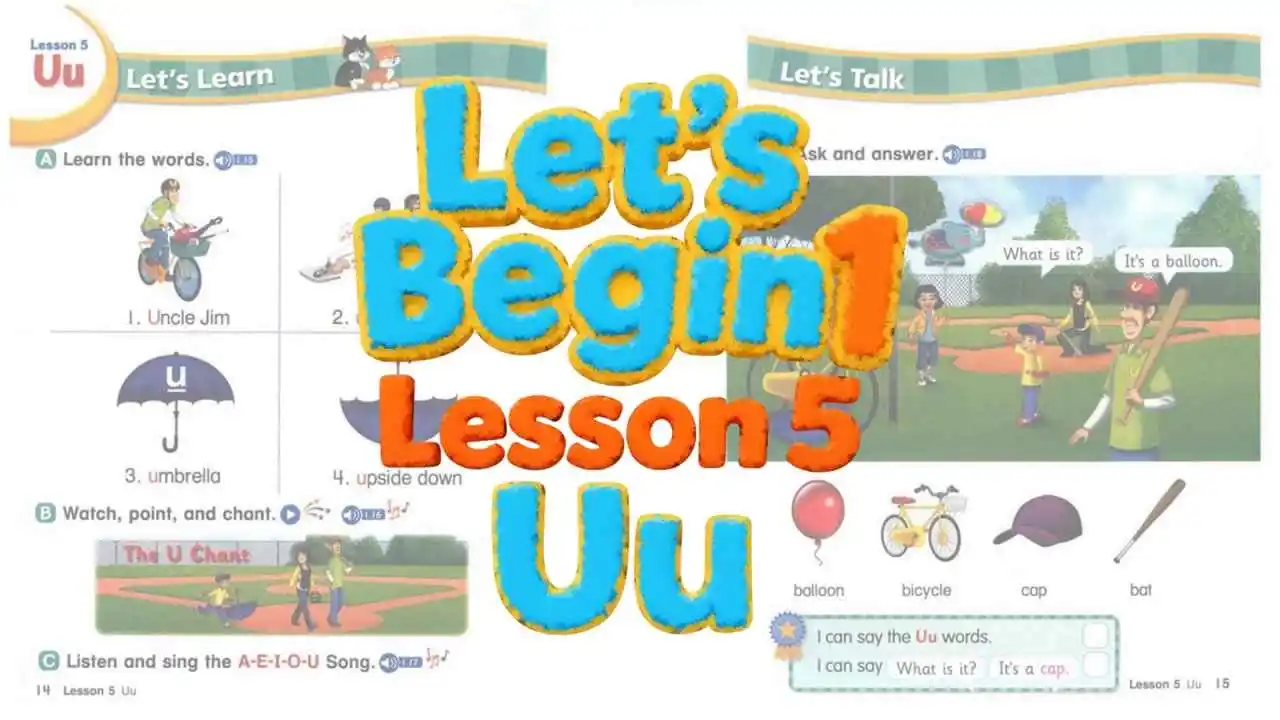
Pronunciation and Usage TipsWords like umbrella and uncle begin with the short /ʌ/ sound—a relaxed, open, and quick vowel sound. To pronounce it correctly:
Non-U words like balloon and bicycle further develop listening comprehension by exposing learners to common consonant-vowel combinations in everyday English. |
How to Write the Letter UuCapital U: Draw a smooth, rounded “U” shape from the top line to the bottom line of your three-line notebook, with both ends touching the top and bottom lines. Lowercase u: Start with a small curve between the middle and bottom lines, then draw a short vertical line downward from the right end of the curve. For best results, young learners should practice writing at least one full line of both U and u in their three-line notebooks. Consistent practice leads to neat, uniform handwriting. |