👁 Views: 2,288
🌟 Word Discovery: Kitchen
Undoubtedly, the kitchen acts as the vibrant heart of every home, serving as a dynamic and natural laboratory for language growth. Therefore, teaching Kitchen English vocabulary for kids effectively turns everyday meal preparation into an interactive, joyful, and immersive classroom. Consequently, you can confidently start your next culinary English adventure today at UCLnet.com.
Step 1: The Setup Phase for Teaching Kitchen English Vocabulary for Kids
To make Kitchen English vocabulary for kids truly practical, adults fundamentally need a structured execution plan rather than vague concepts.
Specifically, whether you are a parent at home or a teacher running a kindergarten workshop, starting with a solid preparation phase remains essential.
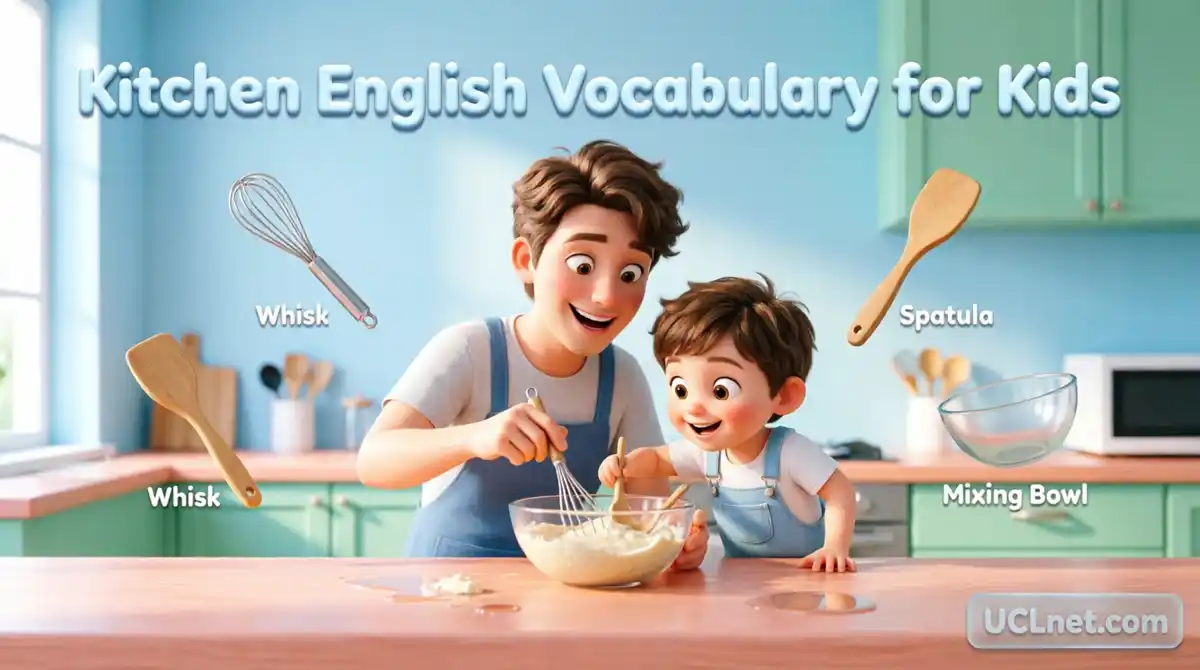
Meanwhile, gathering three or four specific tools like a whisk, spatula, and peeler before beginning any cooking activity comes next.
Then, pointing directly to each item, saying its English name clearly, and gently asking the child to touch it follows right after.
Furthermore, this hands-on physical approach reliably builds a direct, permanent link to the new word.
Step 2: The Action Phase of Cooking English Vocabulary for Children
During active cooking tasks, adults should consistently use single-word commands or short phrases to teach cooking English vocabulary for children effectively.
For instance, instead of speaking in long, confusing sentences, try enthusiastically saying “Stir the bowl!” or “Whisk fast!” while physically demonstrating the exact motion.
As a result, children will naturally mimic your actions and absorb these daily kitchen words for kids effortlessly, without ever feeling pressured by formal study methods.
Step 3: The Review Phase for Learning English in the Kitchen
Immediately after baking finishes, adults must promptly hold up tools one by one and gently prompt children to name them aloud.
In addition, these essential terms stick permanently in memory when they are deliberately repeated across three consecutive sessions over a single week.
Ultimately, by consistently practicing basic kitchen English during regular snack times, educators and parents successfully bridge the crucial gap between passive listening and active speaking.
Real-Life Mini Dialogues for Daily Practice
To guarantee your Kitchen English vocabulary for kids sessions succeed, we highly recommend using these exact, ready-to-use dialogue scripts while preparing meals together:
Dialogue 1: Making Pancake Batter
Adult: “Could you please help me mix the flour and milk using the whisk?”
Child: “Yes, absolutely! I have the whisk ready right here.”
Adult: “Awesome! Now, let’s stir it gently until the batter is completely smooth.”
Dialogue 2: Preparing a Fresh Salad
Adult: “First, we need to slice the fresh cucumbers on the cutting board.”
Child: “I can help peel them first with my safe peeler!”
Adult: “Thank you so much! Finally, remember to sprinkle a little salt on top when we finish plating.”
Extended Mini-Dictionary: Essential Terms
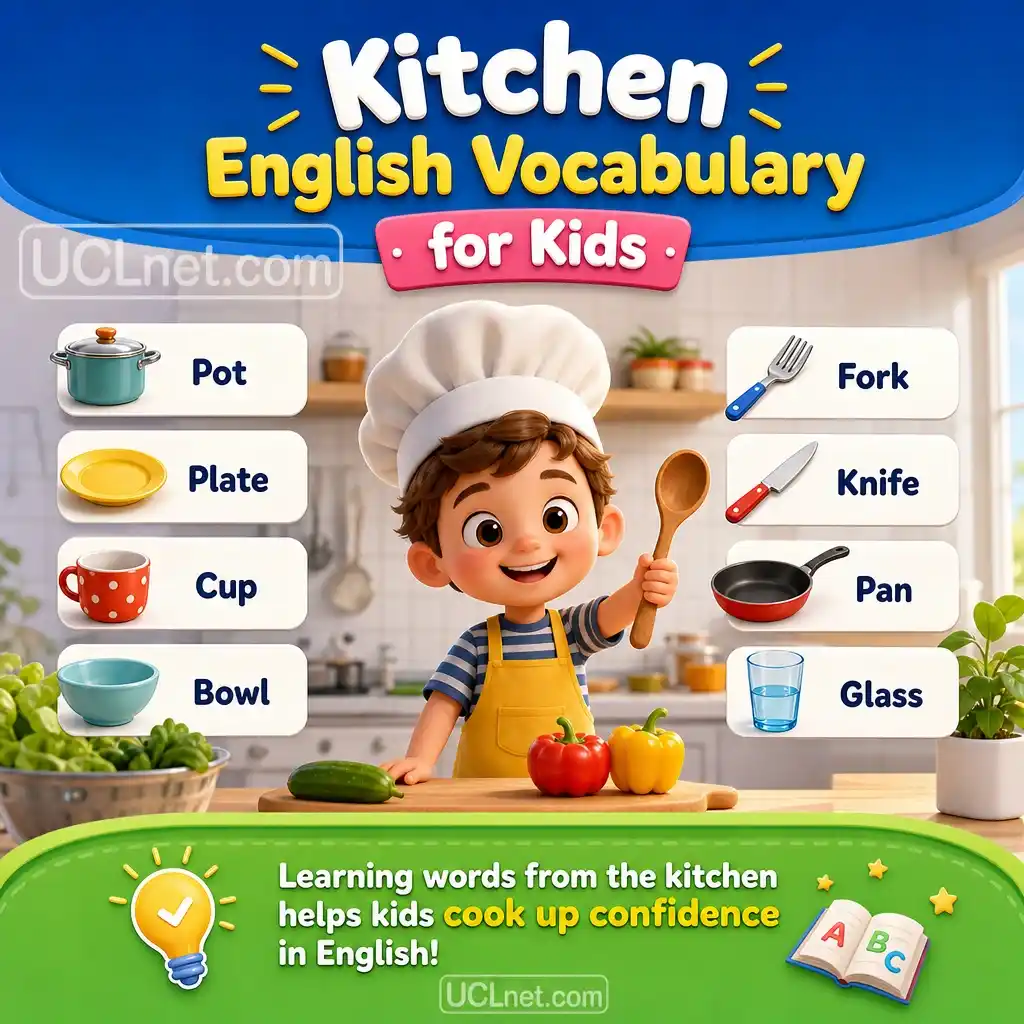
Ultimately, here are expanded key terms for learning English in the kitchen that every child should definitely master during cooking sessions:
Pro-Tip for Parents and Teachers
Indeed, consistency truly remains the ultimate key to language success! Consequently, language experts strongly recommend labeling kitchen appliances and cabinets with waterproof sticky notes. As a matter of fact, when children look at “Fridge,” “Oven,” or “Sink” labels every single day, they naturally absorb the Kitchen English vocabulary for kids visually and effortlessly, without ever feeling burdened by traditional homework.
📝 Language Detective Worksheet
To actively test your knowledge, try this fun interactive quiz below!
Click to see Answer Key
1. Whisk, 2. Sprinkle, 3. True, 4. False, 5. Peeler, 6. Boil, 7. Spatula, 8. Yes, 9. Yes, 10. Yes.
🚀 Master All Basic Concepts!
Unlock the ultimate roadmap to teach 20 essential skills to young learners. Don’t miss out on complete guides and expert strategies!