👁 Views: 2,186
🌟 English Learning Tip 14: The Science of Stress-Free Fluency
Have you ever wondered why your brain remembers every single detail of your favorite video game but forgets a simple list of vocabulary words after just five minutes? The answer is not about your memory power. It is about your emotional atmosphere. When you force your brain to study under heavy stress, it activates a tiny security guard called the amygdala. This guard locks the gates of your memory!
To unlock your true potential, you must master the ultimate secret on how to enjoy learning English at home. By changing your daily environment, you can convince your inner security guard to relax. This changes your entire study routine into an exciting adventure. Let us discover ten vibrant, practical hacks to boost your language fluency naturally at UCLnet.com!
Example: “Learning how to enjoy learning English without heavy pressure helps you speak like a native superstar!” 🪐
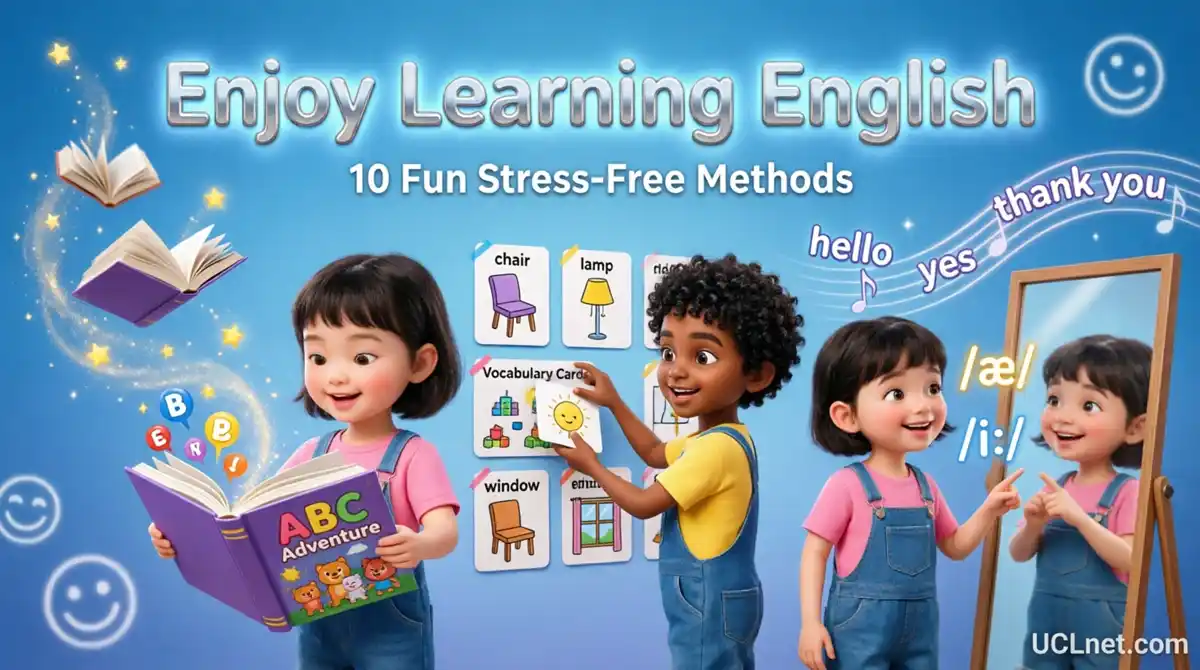
10 Creative Methods on How to Enjoy Learning English Without Feeling Bored at All
Transforming your study space into a fluid language kingdom does not require expensive tools. You can use these ten creative steps to keep your motivation high and drive away boredom completely:
1. The Neon Vocabulary Wall: Write tricky active verbs on bright neon paper. Stick them on your mirror so you review phrases while brushing your teeth.
2. Binaural Background Beats: Play low-volume lo-fi or classical soundscapes. This simple trick shields your ears from noisy neighborhood interruptions.
3. The 15-Minute Token System: Set a physical timer for fifteen minutes. When it rings, reward yourself with a shiny star sticker or a healthy treat.
4. The Comic Book Swap: Replace traditional heavy textbooks with illustrated graphic novels. Pictures help your mind grab abstract adjectives instantly.
5. The Furniture Labeling Game: Attach small sticky cards to everyday household items like the fridge, the wardrobe, or the armchair to learn nouns passively.
6. The Lazy Audiobook Corner: Create a soft nest with giant pillows on your floor. Lie down comfortably while listening to beautifully animated fairy tales.
7. The Mirror Mirror Talk: Stand in front of your mirror and describe your current outfit using three sentences. This builds massive speaking confidence.
8. The Dinner Table Passport: Ask your parents to join you in a game where everyone must name one English object before starting to eat dinner.
9. The Password Challenge: Set a new vocabulary word as your tablet or computer password. Typing it daily forces you to memorize the exact spelling.
10. The Mood Tracker Journal: Draw a tiny smiley face next to the date every time you complete a worksheet to visualize your positive emotional progress.
📚 Mini Dictionary for Young Scholars
| Word | Child-Friendly Explanation & Example |
|---|---|
| Atmosphere | The general mood, feeling, or vibe that a room gives you. “My room has a happy study atmosphere.” |
| Chore | A boring task that you are forced to do regularly. “Cleaning the dishes is a boring chore.” |
| Transform | To change the look or feel of something completely. “I will transform my old desk into a spaceship station.” |
| Motivation | The energetic feeling of wanting to complete a goal with joy. “The gold medal gave the runner heavy motivation.” |
| Interrupt | To stop someone or something in the middle of an action. “Please do not interrupt me while I read.” |
| Passive | Learning or doing something naturally without working too hard. “Listening to songs is a passive way to learn vocabulary.” |
| Fluency | The ability to speak a foreign language smoothly and quickly without stopping. “Daily practice brings high speaking fluency.” |
| Abstract | An idea or concept that you cannot touch with your hands. “Love and kindness are abstract words.” |
| Amygdala | A tiny, almond-shaped part of your brain that handles feelings like stress or fear. “The friendly dog helped the little girl’s amygdala relax.” |
| Convince | To make someone feel sure that something is a great idea. “I tried to convince my friend to join our learning game.” |
| Boredom | The tired, unhappy feeling you get when you have nothing exciting to do. “Our new color cards drove away all of our afternoon boredom.” |
| Lo-Fi | Cozy, slow-tempo background music with soft beats that help your mind focus. “I love listening to gentle lo-fi music while drawing my picture maps.” |
📝 Master Level Challenge (10 Questions)
Writing Challenge: Write one clear sentence about which of the 10 methods you want to try first in your room!
✳️ Upgrade Your English Journey
Want to explore more practical learning tricks? Check out our special categories and video resources:
Our YouTube Channel