👁 Views: 3,369
Bear vs Bare: Meaning, Differences & Fun Quiz for Kids
What Is the Difference Between Bear and Bare?
Have you ever wondered why two English words can sound completely identical when spoken out loud while describing a wild furry forest animal in one sentence and walking around with no shoes in another? Naturally, when young students write creative stories or complete school assignments, they frequently encounter confusing homophones like bear vs bare that create spelling puzzles. Although these terms share the exact same pronunciation, understanding the difference between bear and bare requires looking closely at their distinct spellings, multiple meanings, and grammatical roles.
Furthermore, caring teachers and supportive parents always look for straightforward methods to guide children through tricky vocabulary without feeling overwhelmed. Therefore, this comprehensive guide provides clear definitions, simple pronunciation guides, smart memory tricks, practical examples, and an interactive quiz to make learning effortless and enjoyable. Consequently, mastering bear or bare empowers every child to write and speak with complete confidence. In addition, exploring these language nuances early on helps students build a solid foundation for learning English vocabulary.
Specifically, knowing how to choose between bear and bare stops you from mixing up a giant grizzly bear in the woods with walking on the beach with bare feet!

Bear vs bare grammar rules lesson for kids – UCLnet.com
Deep Dive Into Bear Meaning, Animals, and Enduring
First of all, let us examine our first term in this bear vs bare lesson. What is the true bear meaning? Spelled with ‘ea’ in the middle, it is a versatile word functioning as both a noun and an action verb. As a noun, it represents a large, heavy wild animal with thick fur, such as a grizzly, panda, or polar bear. As an action verb, it has multiple fascinating meanings: to carry a heavy load, to support weight, to endure difficult pain or hardship, or to give birth to young offspring. Pronunciation Guide for Kids: Spoken simply as (BAIR), rhyming with “hair” and “chair.” Consequently, recognizing bear or bare in reading exercises becomes much easier for young learners. Furthermore, here are key ways to understand its usage:
1. Wild Forest Animal (Noun)
Meaning: A large, powerful wild mammal living in forests and mountains.
Example: Accordingly, the brown bear caught a fresh fish in the cold river.
2. Enduring or Carrying (Verb)
Meaning: To tolerate difficult situations, carry weight, or withstand pressure.
Example: Similarly, she had to bear the loud noise while studying for her spelling test.
Difference between bear and bare for young learners – UCLnet.com
Exploring Bare Meaning, Nakedness, and Revealing
Meanwhile, let us explore our second grammar term in this bear vs bare guide. What is the complete bare meaning? Spelled with ‘ar’ in the middle, it functions primarily as an adjective meaning naked, uncovered, empty, or basic (such as bare feet or tree branches in winter). In addition, it can function as an action verb meaning to uncover or reveal something hidden (such as to bare your soul or bare your teeth). Pronunciation Guide for Kids: Spoken identically as (BAIR), rhyming with “care” and “pear.” Therefore, learning the difference between bear and bare helps young writers describe scenery and actions clearly. Moreover, practicing these words daily expands vocabulary confidence.
1. Naked or Uncovered (Adjective)
Meaning: Not covered by clothing, shoes, or leaves; completely empty.
Example: Specifically, he walked across the warm sand with bare feet.
2. Revealing or Uncovering (Verb)
Meaning: To expose something to view or remove a covering.
Example: Likewise, the angry dog started to bare its sharp teeth.
Quick Comparison: Bear vs. Bare
In short, to make the difference between bear and bare crystal clear before taking our practice quiz, please review this quick summary chart:
| Word | Grammar Role & Core Meaning | Example Sentence |
|---|---|---|
| Bear | Noun & Verb • Wild animal, carry, or endure. | Therefore, the large bear walked in the forest. |
| Bare | Adjective & Verb • Naked, empty, or uncover. | Consequently, the winter tree branches were bare. |
Teacher & Parent Guidance & Memory Tricks
Furthermore, parents and classroom teachers can use these smart tips during study time when teaching bear vs bare for kids:
- The Ear Animal Trick: First, notice that b-ea-r has the word ‘ear’ inside it, just like the furry ears of a forest animal!
- The Art Uncovered Trick: Second, remind kids that b-ar-e has ‘ar’ like art, meaning a blank canvas or uncovered space!
- Common Expression Connection: Additionally, teach kids phrases like “bear with me” (have patience) and “bare minimum” (the smallest amount).
- Real-Life Error Correction: However, students frequently confuse bear or bare and write: “He walked outside with bear feet.” As a result, this sentence is incorrect because uncovered feet are bare.
Easy Everyday Dialogues for Kids
In addition to memorizing spelling rules, reading short dialogues aloud helps kids practice bear vs bare in natural sentences. Thus, try practicing these conversations with friends:
Dialogue 1:
Camper: “Look at the giant footprints in the muddy trail!”
Guide: “Actually, those belong to a wild grizzly bear looking for berries.”
Dialogue 2:
Mom: “Put on your shoes before stepping outside on the pavement.”
Child: “Therefore, I will, because my bare feet feel cold on the sidewalk!”
Mini Dictionary for Young Learners
Before taking the interactive quiz below, please review these key vocabulary terms pulled directly from our bear vs bare lesson text:
| Word | Simple Meaning | Example Sentence |
|---|---|---|
| Endure | To suffer through or tolerate something difficult. | For example, athletes endure hard training sessions. |
| Naked | Without clothes, covering, or protection. | Consequently, walking outside with bare feet means being naked of shoes. |
| Uncover | To remove a cover or reveal something hidden. | Meanwhile, pulling back the curtain helps to bare the window. |
| Mammal | A warm-blooded animal with fur that feeds milk to babies. | Moreover, a grizzly bear is a wild forest mammal. |
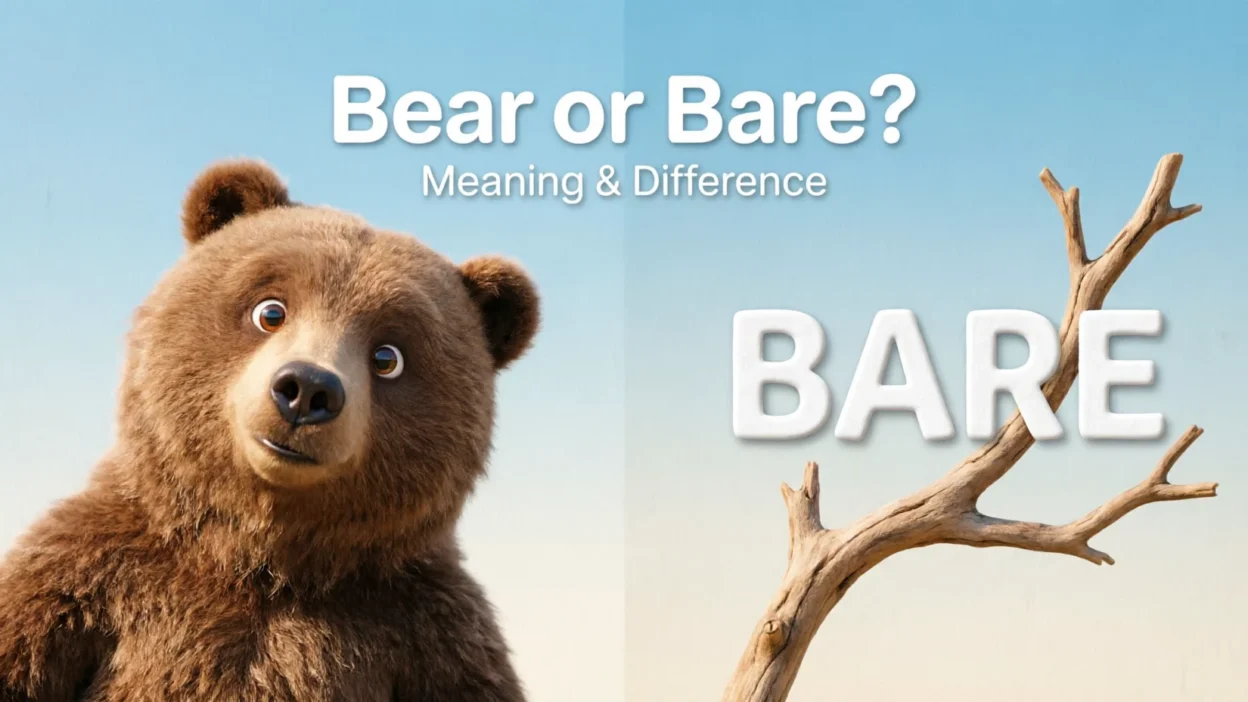
Spelling trick for bear vs bare – UCLnet.com
Practice Quiz: Bear vs. Bare
Therefore, test your knowledge of bear vs bare by trying these ten practice questions:
Click here to show Answer Key
1. A large, heavy wild animal with thick fur
2. True
3. Endure
4. bare
5. True
6. The brown bear caught a fish in the river.
7. Mammal
8. To prevent spelling errors and build writing confidence
9. bear
10. It has ‘ear’ like the furry ears of an animal
Explore More Related Categories
Want to discover more English vocabulary lessons like bear vs bare and other confusing words? If so, explore our related categories below: