👁 Views: 2,141
🌟 Word Discovery: Failure is not in my vocabulary
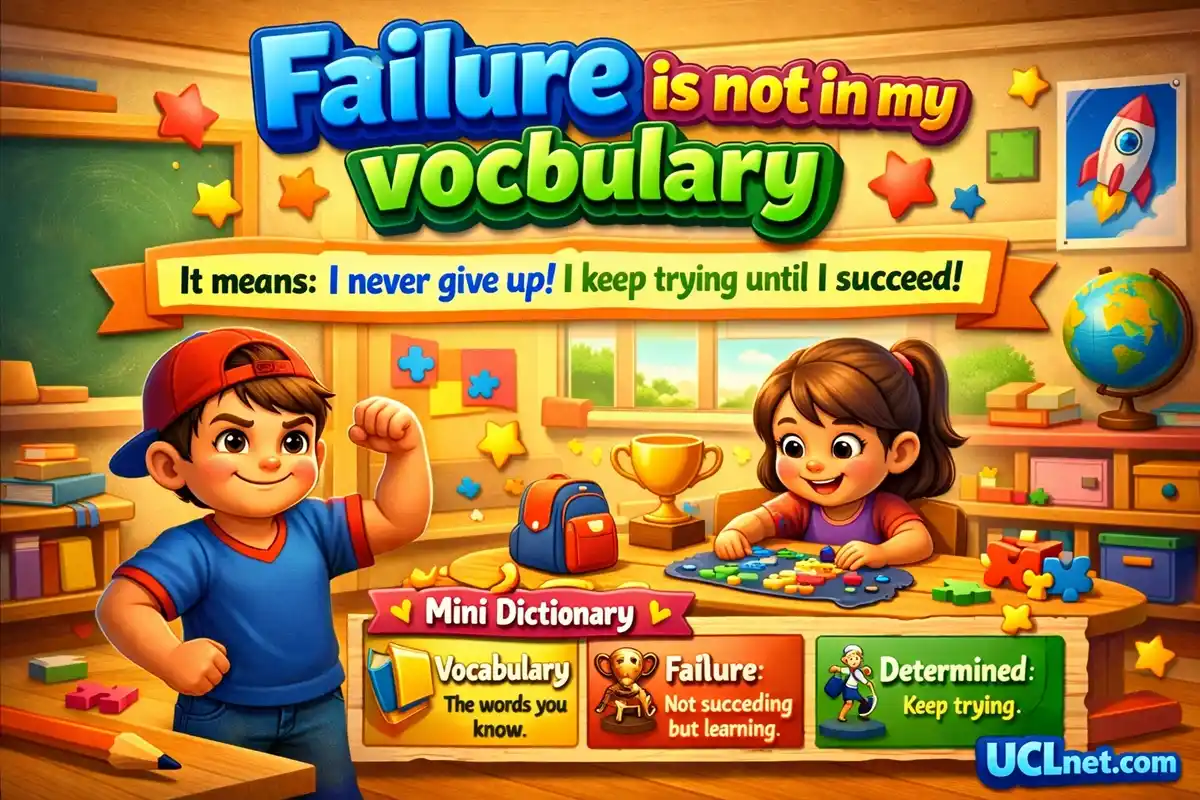
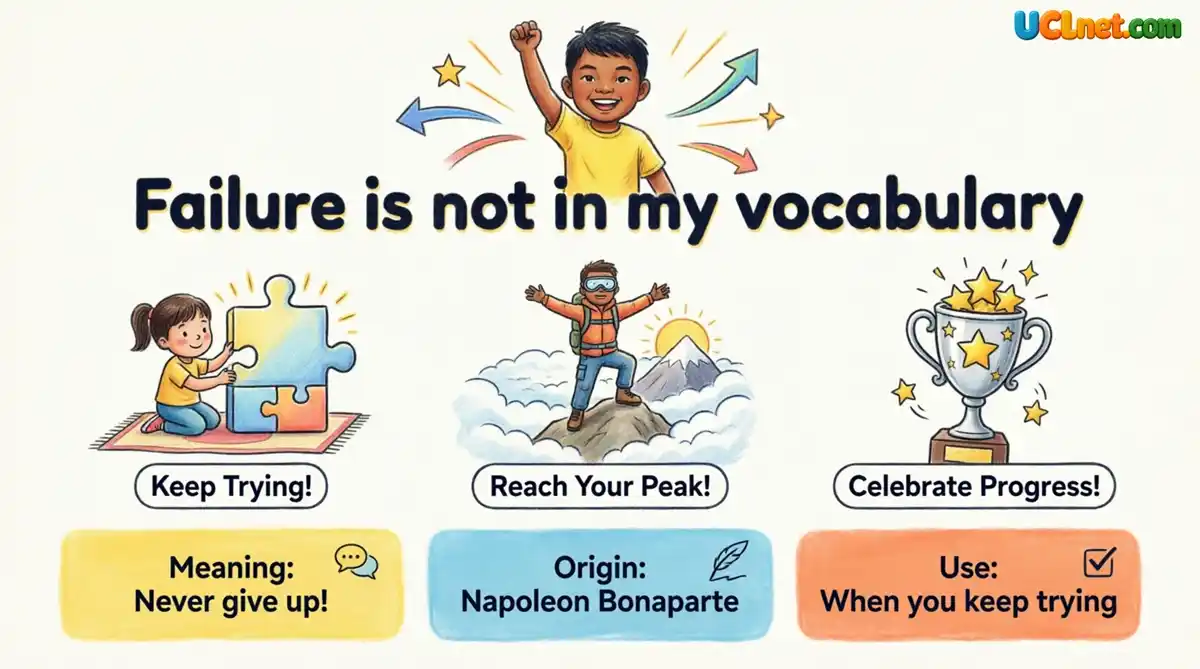
When you say “Failure is not in my vocabulary,” it means you have a super power! It means you will never give up. Even if a puzzle is hard or a game is tough, you keep trying. You do not let the word “lose” enter your mind. Are you ready for your next international English adventure at UCLnet.com?
Example: “The clever girl tried to solve the math puzzle again and again because failure was not in her vocabulary!” 🧠
“Failure is not in my vocabulary 🌟 English Idiom
The True History of Failure Is Not in My Vocabulary for Kids
A long time ago, there was a famous French leader named Napoleon Bonaparte who wanted to win every single battle. One sunny morning, his helper ran to him and said that crossing a huge, icy mountain was completely impossible. However, Napoleon got very surprised and shouted that the word “impossible” was not in his dictionary!
Consequently, people around the world loved this brave attitude. Over the years, they changed the story slightly to create a strong motivational idiom for kids. Because children learn words to build confidence, the phrase changed into “failure is not in my vocabulary.” Therefore, whenever you face a hard test, you can think of this brave leader crossing the cold mountains.
Who Uses the Never Give Up Idiom for Children?
First, amazing sports coaches use this phrase on the soccer field. They want their young players to run fast and keep smiling even if they are losing the game. Second, loving parents use it at home when children are practicing hard tasks like riding a bicycle or tying their shoes.
In addition, brilliant scientists and brave astronauts always repeat this phrase. When their big rockets do not fly on the first try, they do not get sad. Instead, they quickly fix the engines because they truly believe that failure is not in their vocabulary.
The Real Meaning of Failure Is Not in My Vocabulary
So, what do big English dictionaries tell us about this mindset? If you look closely at their explanations, they all agree on one big secret. To have this vocabulary means you refuse to accept a bad result.
For instance, instead of crying over a mistake, a determined child smiles and tries again. Thus, the idiom simply means that losing is never an option in your beautiful mind. You look at a mistake as a cool stepping stone toward success.
Fun Everyday Examples for Young Learners
Example 1: “Even though the English reading lesson was very long, Tim kept trying to pronounce the big words because failure was not in his vocabulary.”
Example 2: “Emma practiced her new song on the piano every single afternoon until she played it perfectly. Clearly, failure is not in her vocabulary!”
Easy Vocabulary Builder for Kids
Let us learn some friendly and powerful new words from our idiom lesson today!
| Word | Meaning (Simple English) |
|---|---|
| Vocabulary | All the lovely words that live inside your head and your speech. |
| Failure | Making a mistake, which is actually a secret way to learn and grow. |
| Idiom | A magic phrase where the words join together to create a completely new meaning. |
| Determined | Having a strong heart that tells you to keep trying without stopping. |
| Leader | A brave person who guides, helps, and shows the right way to a group. |
Failure is not in my vocabulary 💪
Motivational Idioms for Kids Worksheet
Test your knowledge and practice your English skills with these fun exercises!
🔑 Answer Key (For Parents & Teachers)
Part 1: 1. B | 2. B
Part 2: 3. False | 4. True
Part 3: 5. leader | 6. failure | 7. vocabulary
✳️ Explore More Related Lessons
Want to practice more? Check out our special categories and channels for young learners:
Watch animated videos on our channel: